The shift from periodic audits to real-time monitoring
Across lending, factoring, and credit-intensive businesses, one shift is happening everywhere: periodic audits are giving way to continuous, automated monitoring. Quarterly or annual reviews were built for a slower world. They can't keep pace with regulatory change or the day-to-day volatility inside a borrower's risk profile.
The cost of waiting is real. A client you underwrote thoroughly six months ago can have their DOT rating tank, pick up a judgment, or let a registration lapse, and you won't know until the next scheduled review. By then the damage is done. Credit risk management software closes that gap by watching the portfolio continuously instead of in snapshots.
This isn't a cosmetic upgrade. It is a move toward catching issues earlier, reducing exposure, and stabilizing compliance.
Why continuous monitoring matters
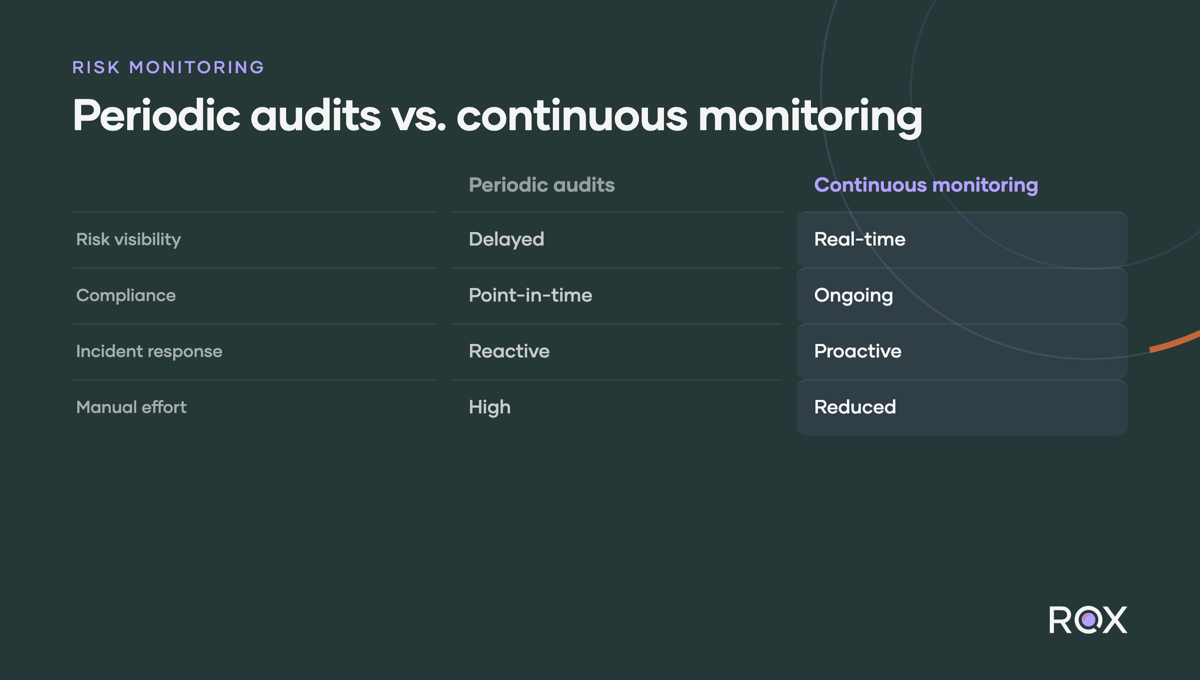
Continuous monitoring gives your team up-to-date visibility instead of backward-looking reports. When risk signals update in real time, you identify shifts as they happen, not weeks later. Automation also reduces manual work and cuts error rates, which frees analysts to focus on decisions rather than data cleanup.
Organizations using automated, real-time monitoring consistently see stronger compliance performance and faster incident response than those relying on periodic checks. Regulators are also moving toward expectations of continuous compliance rather than point-in-time validity.
| Benefit | Periodic Audits | Continuous Monitoring |
|---|---|---|
| Risk visibility | Delayed | Real-time |
| Compliance assurance | Point-in-time | Ongoing |
| Incident response | Reactive | Proactive |
| Manual effort | High | Reduced |
What real-time credit risk monitoring tracks
Effective monitoring is built on a few core components:
- Real-time data access that keeps risk assessments current
- Automated alerts when thresholds or patterns shift
- Integration with underwriting and GRC platforms so views aren't siloed
- Centralized dashboards showing live client activity and exceptions
- Predictive analytics to surface trends a manual review would miss
Clear ownership, workflows, and escalation rules keep the system from becoming noise.
Anchor it with Key Risk Indicators
KRIs turn risk into something measurable and traceable. Choose indicators tied to your specific risk landscape: changes in financial behavior, overdue compliance tasks, lien activity, or operational anomalies. Define a quantifiable metric for each, review them as your portfolio shifts, and track them automatically. A living risk register, updated continuously, keeps the team aligned and provides a clear audit trail.
Continuous control monitoring in practice
Continuous control monitoring (CCM) automates the testing of internal controls. Instead of sampling or manual validation, controls are validated continuously. The steps are straightforward: select technology that integrates with your existing systems, define workflows for alerts and remediation, and ensure it scales as volume and regulation grow. CCM turns control testing into an ongoing assurance function and shrinks the lag between an issue occurring and being detected.
It only works if it fits your workflow
Monitoring delivers value when it lives inside the tools your team already uses. Prioritize compatibility with your underwriting and data sources, centralized dashboards that eliminate fragmented views, and policy management built into the platform.
This is the direction the industry is moving: consolidated workflows rather than a dozen disconnected tools. ROX brings underwriting, third-party data, UCC activity, and continuous client monitoring into one place, so monitoring sits alongside the decision instead of in a separate system.
Measure it, then improve it
Monitoring improves when it's measured. Track the frequency of assessments, incident response times, escalation rates, and completion of compliance tasks. Teams that review these metrics regularly build stronger, more adaptable programs.
The bottom line
Automated, real-time credit risk monitoring is becoming the standard for lenders, factors, and risk-focused teams. It delivers faster insight, steadier compliance, and fewer surprises. As regulatory expectations grow, the gap will widen between teams with real-time visibility and those still relying on quarterly snapshots.
See how ROX monitors your portfolio around the clock. Get started free with three free applications. No card, no demo required.