Factoring profitability is at an inflection point
You are signing more clients. You are processing more invoices. So why does factoring profitability feel tighter every quarter? The math confirms what you are feeling: U.S. invoice factoring revenue has declined at an annualized 4.4% over the past five years, even as the global market is projected to reach $5.69 trillion in 2025.
That is the disconnect. Demand is high, but local profit pools are shrinking. Competition is sharper, regulators in California and New York are making compliance expensive, fraud is getting harder to catch, and operating expenses are rising faster than revenue. You cannot solve this by adding more volume. That model is broken. The firms holding their margins are the ones using invoice factoring software to underwrite faster, price risk correctly, and break the link between revenue growth and headcount growth.
The growth trap: more clients, less income
The real story is in the operating data. The Secured Finance Network's 2024 Year-End Factoring Survey shows client counts up 24.1%, expenses up 31.3%, and pre-tax income down 2.1%. Read that again. You are doing more work for smaller tickets, servicing more clients, and paying more for staff and compliance. The result is a drop in bottom-line income.
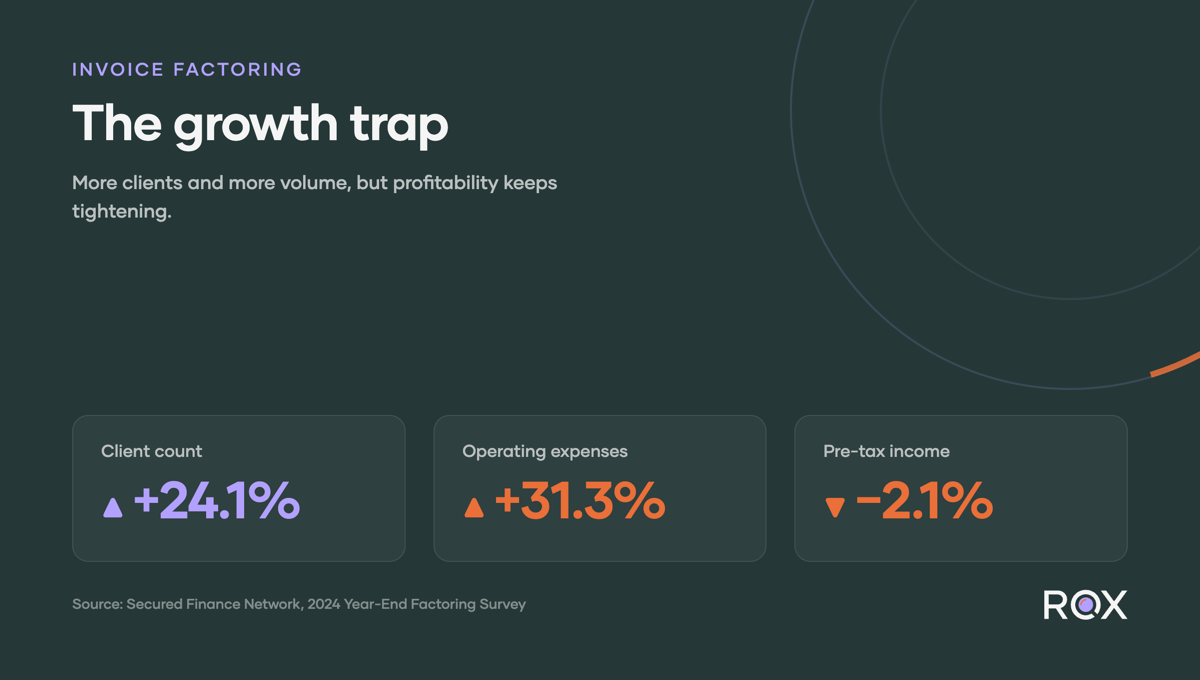
Volume no longer guarantees profitability. It might actually be hurting it.
| Metric | Direction | Key Figure |
|---|---|---|
| U.S. Revenue | Declining | -4.4% annually |
| Global Market | Growing | 7.8% CAGR to $5.69T |
| Client Count | Surging | +24.1% |
| Expenses | Spiking | +31.3% |
Where the money actually leaks
To fix margins, you have to be honest about where the money goes. Revenue is the simple part: discount fees, service charges, ancillary fees. The costs are where the leaks happen. Sustainable factoring profitability depends on aligning advance rates and fees with the true cost of servicing each client. High-maintenance clients and slow-paying obligors quietly eat your discount fee.
Four drivers do most of the damage. Cost of funds has climbed, and if you have not repriced, your spread is thinner. Credit losses are brutal because one fraud hit wipes out the fees from fifty good clients. Servicing low-quality invoices means manual intervention, which is pure labor cost. And compliance adds a fixed cost to every deal through new state disclosures. When you are signing smaller clients, that fixed cost devours a larger share of every margin.
The structural squeeze
Fintechs and alternative lenders have driven down discount spreads and pushed for higher advance rates. If you compete solely on price, you lose, because there is always someone willing to fund a deal at a loss to buy market share. At the same time, the industry is shifting toward non-recourse factoring, which moves the risk onto your balance sheet. That is profitable when priced correctly and a ticking time bomb when it is not.
Regulation is now a line item on your P&L, not a legal footnote. You are navigating California SB 1235, New York's NYCRR 600, and new rules in Utah, Florida, and Georgia, each requiring specific disclosures and rigorous tracking. Fraud is climbing alongside default risk, especially in transportation factoring, where fast funding and fragmented documentation make an easy target. Deeper underwriting and more verifications are necessary, but every manual check drives up your cost per dollar funded. If you do not automate them, your expense ratio keeps climbing.
How invoice factoring software reverses the trend
Automation is the only lever that lowers your unit economics. The right invoice factoring software for factors ingests documents, scores risk, and flags fraud signals at the door, so you scale volume without scaling payroll. Here is where to focus.
Fire the unprofitable clients. Stop chasing volume and shift to segment-level profitability. Analyze your book, find the clients who generate high workload and low margin, then reprice or exit them. Concentrate capital where risk-adjusted returns make sense.
Compete on value, not rate. Do not be the cheapest. Offer sector expertise and cash-flow guidance. When clients see you as a partner who helps them grow, they stop haggling over half a point.
Automate the back office. You cannot afford humans doing data entry. Automate document collection, invoice verification, and routine communication, or every new client adds linear cost. Automated underwriting is how you break the link between revenue growth and expense growth, and how you keep approvals fast enough to win the deals worth winning.
Implement risk-based pricing. Tier discount rates by debtor quality and invoice aging. If a client needs non-recourse funding or operates in a high-risk vertical, charge for it, and show them why the rate is what it is. Transparency becomes a feature, not friction.
Your 12-month playbook
| Phase | Window | Focus |
|---|---|---|
| Triage | 0–3 months | Run per-client profitability analysis, reprice or exit the losers, fix pricing where cost of funds is misaligned |
| Automate | 3–9 months | Standardize KYC and state-disclosure workflows, automate data entry and invoice verification, stop manual system-hopping |
| Modernize risk | 6–18 months | Deploy continuous fraud monitoring and use data to refine advance rates |
| Reposition | 9–18 months | Pick your lane, because specialization pays better than generalist factoring, and market your transparency |
Margin compression is real, but it is not inevitable. Firms that rebalance pricing, automate the grunt work, and fire their bad clients can restore healthy factoring profitability. The constraint is no longer demand. It is whether your operation can underwrite and price fast enough to keep the margin you earn.
See how ROX helps factors underwrite faster and protect margins. Get started free with three free applications. No card, no demo required.
References
- Invoice Factoring in the US Industry Analysis, 2025 — IBISWorld
- Factoring 2024: Solid Footing in Uncertain Times — SFNet
- Regulatory Compliance for Factoring Companies — XEN Platforms
- Factoring Global Market Report 2025 — The Business Research Company
- How AI Is Transforming Factoring Companies — State Financial
- Factoring and Profit Margins: What You Need to Know — Invoice Factoring Guide