From manual review to automated underwriting
Automated underwriting software uses rules, data extraction, and predictive models to evaluate standard applications in minutes instead of days. It does not replace the underwriter. It clears the routine work off their desk so judgment goes where it matters. The Mortgage Bankers Association projects single-family originations of $2.2 trillion in 2026, an 8% increase over 2025, and that volume is arriving at teams still toggling between disconnected systems.
Manual underwriting is not disappearing. It is evolving. Automation has succeeded at handling repetitive, standardized cases, and that success frees underwriters to apply human judgment to complex borrower scenarios. The question is no longer manual versus automated. It is how to orchestrate both.
Why speed became the battleground
Borrowers and policyholders now expect instant decisions and frictionless digital journeys. High drop-off rates tell the story: industry data shows nearly 40% of mortgage applicants abandon their applications because of slow response times and unclear next steps. When the process is not fast and transparent, the customer leaves for a competitor.
The cost of slowness compounds. The average cost to originate a mortgage has hovered over $10,000, and much of that is the "toggle tax" of switching between legacy systems. What should be a 48-hour decision becomes a 10-day ordeal, and somewhere in that delay the deal dies. Underwriting automation is how competitive lenders close the gap.
Manual vs. automated: where each one wins
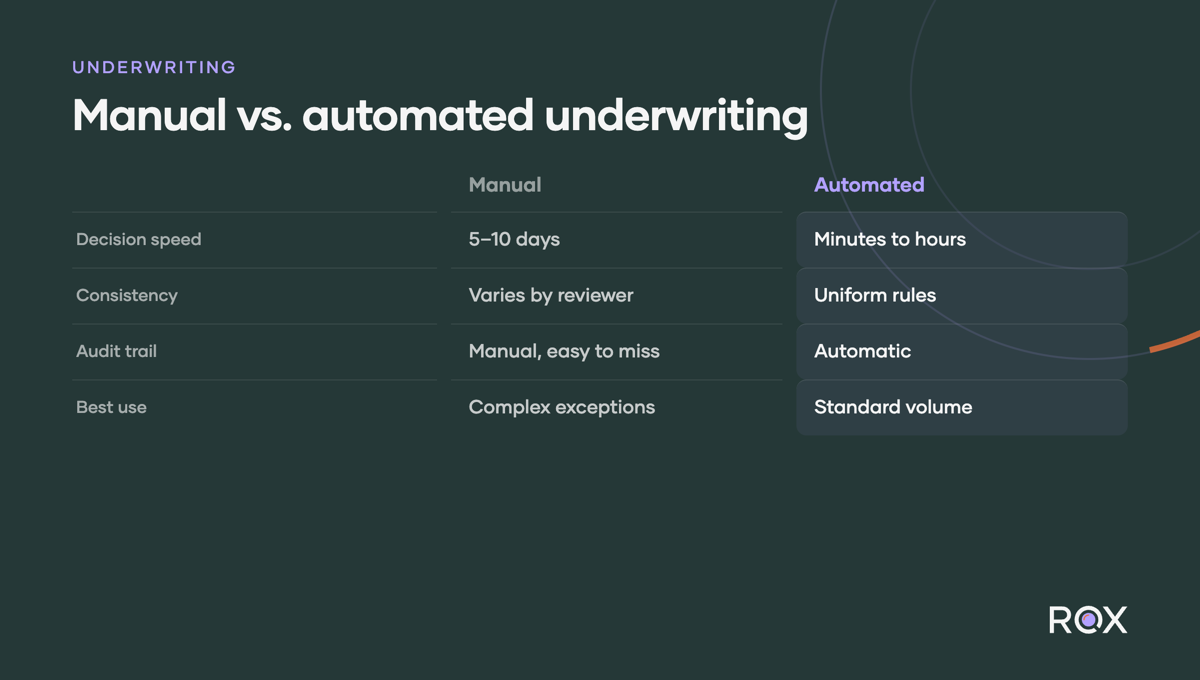
Each model has a clear lane. Automated systems deliver speed and consistency for standard files. Manual review delivers nuance and flexibility for the exceptions that do not fit a rule.
| Dimension | Manual Underwriting | Automated Underwriting Software |
|---|---|---|
| Decision speed | 5–10 business days | Minutes to hours |
| Flexibility | High (weighs compensating factors) | Limited to programmed rules |
| Consistency | Variable across underwriters | Uniform rule application |
| Audit trail | Manual, easy to miss | Automatic and complete |
| Best fit | Complex, non-traditional borrowers | Standard, straightforward applications |
Automated underwriting excels at consistency for standard scenarios. Manual underwriting excels at telling a borrower's complete story: the income dip that was a planned sabbatical, the bankruptcy that came from medical bills, the self-employed applicant whose tax returns show strength behind the volatility. An algorithm sees variance and declines. A human sees a successful business and approves.
The hybrid model: automate the routine, keep the judgment
Modern lenders solve this with a hybrid workflow. Let automation do what it does best, then reserve human review for the cases that need it.
- Initial screen. Automated systems run credit checks, income verification, and ratio calculations.
- Standard approval. Files that meet criteria are approved or routed for a quick final check.
- Exception handling. Files that trigger exceptions escalate to senior underwriters with full context and supporting analysis already assembled.
The payoff is measurable. Document collection and OCR can cut handling time 40–50%, automated income verification 60–70%, and real-time compliance checks 70–80%. The underwriter's role shifts from data gatherer to risk strategist.
The speed trap: why fast without quality fails
Speed alone is dangerous. Quality control data shows manual processes carry higher defect rates, but automation introduces its own risk if it is deployed without discipline. Inconsistent standards, undocumented decisions, and unexplained model outputs create regulatory exposure that no turnaround time can justify.
Regulators are enforcing Explainable AI standards. Models must be auditable, decisions must be justified, and outcomes must be free from bias. Recent HMDA data showing denial rates for Black applicants near 19–20%, roughly double the rate for White applicants, is exactly why speed cannot come at the cost of fairness. The right automated underwriting software bakes compliance in, embedding audit trails and decision rationale rather than bolting them on later.
Putting it into practice
Converting manual underwriting to digital workflows is an organizational change, not a software install. A few principles keep it on track:
- Map the process first. Document where bottlenecks occur and which decisions genuinely require human judgment before you automate anything.
- Unify the stack. Consolidate credit reports, background checks, UCC filings, and bank monitoring into one place instead of a dozen disconnected tools.
- Preserve human judgment. Design the system to escalate exceptions to experienced underwriters with full context attached.
- Train for the override. Staff need to know when to trust automation and how to overrule it when the file demands it.
This is the direction the industry is moving: consolidated, compliant workflows rather than fragmented point solutions. ROX brings automated underwriting together with third-party data, UCC activity, and continuous monitoring, so underwriters get complete applicant context in minutes and the decision and the data live in the same system.
The bottom line
Manual judgment will always matter for complex borrowers. What is changing is how that judgment is delivered. The winners in 2026 will be the teams that automate the routine, protect the human element for the exceptions, and refuse to trade quality for raw speed.
See how ROX automates underwriting. Get started free with three free applications. No card, no demo required.
References
- What is Automated Underwriting Systems? Guide for 2025 — Rocket Mortgage
- AI in Mortgage Underwriting: What's Changing in 2025 & Beyond
- Mortgage QC Industry Trends — Q1 2025, ACES Quality Management
- MBA Mortgage Finance Forecast and HMDA Data Analysis 2024–2025
- High Drop-Off Rates: What That's Telling You About Borrower Experience — HousingWire
- Five Trends Driving Digital Mortgage Solutions — McKinsey